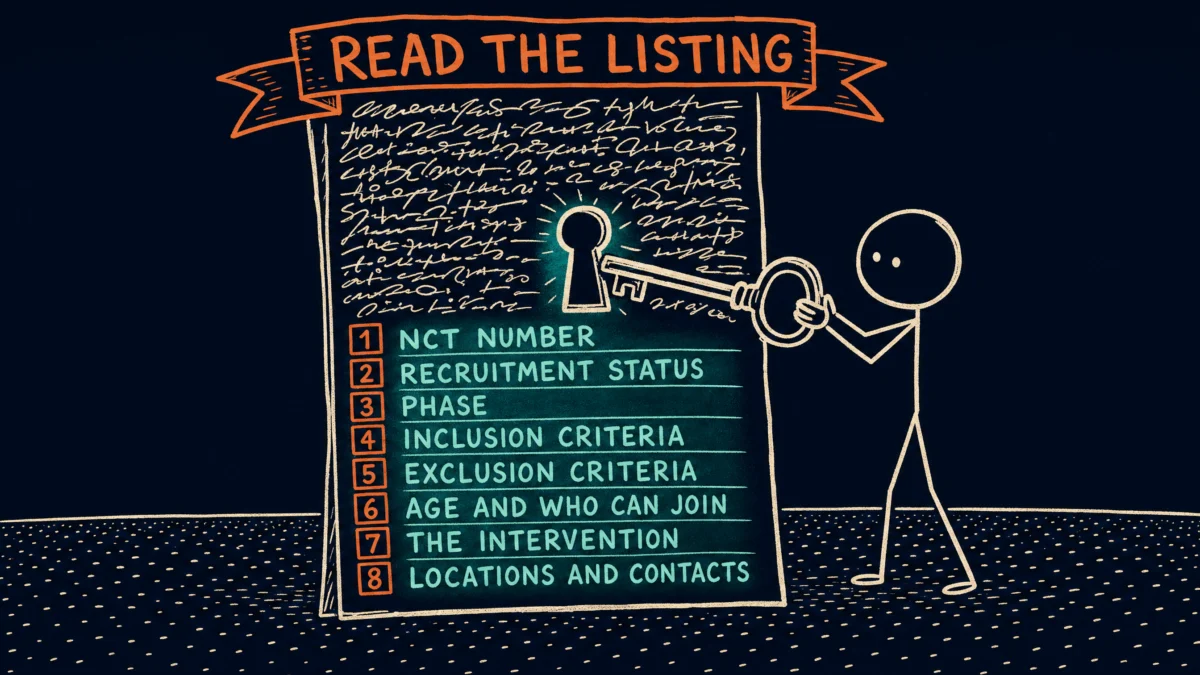
A diagnosis sends most people to the same place: a search bar. You type the disease. You land on ClinicalTrials.gov, the official U.S. government registry. And you hit a wall.
The page was built for researchers, not for you. It uses words like arm and endpoint and Phase 2. It lists inclusion criteria and exclusion criteria in a block of medical shorthand. You are trying to answer one plain question. Could this study help me, or my child? The page does not make that easy.
I am a pediatric cancer doctor. I have sat with families holding a printout of one of these listings, unable to tell if it applied to them. The information was all there. It was just locked behind language.
This guide is the key. It walks through the eight parts of a trial listing that actually matter, in plain words. Read it once and you can read any listing on the site.
Why these eight
I run clinical trials for a living. I also build software, and I made a tool that rewrites these listings in plain language, so I have read thousands of them looking for the parts that trip people up. These eight are the ones families get stuck on every time. I left out the fields that only matter to the study staff.
1. The NCT number
This is the study’s ID. It always looks like NCT followed by eight numbers, like NCT00000419. Write it down. It is the fastest way to find the exact study again, hand it to your doctor, or ask about it by name. Every registered U.S. trial has one.
2. Recruitment status
This tells you if the study is open. The words are exact, and each one means something different:
- Recruiting: open and looking for people right now. This is the one you want.
- Enrolling by invitation: only open to people the researchers already chose. You cannot ask to join.
- Active, not recruiting: running, but not taking new people.
- Completed: finished.
- Withdrawn: stopped before it enrolled anyone.
Only Recruiting means you can try to get in today.
3. Phase
The phase tells you what the study is testing, and how much is already known:
- Phase 1: Is it safe? Small, early, working out the dose.
- Phase 2: Does it work, and is it still safe? Larger.
- Phase 3: Is it better than the current standard treatment? Large, often the last step before approval.
- Phase 4: Watching a treatment that is already approved.
A Phase 1 study is not worse than a Phase 3. They answer different questions. But the phase tells you how new the treatment is.
4. Inclusion criteria
These are the requirements you must meet to join. Age, the type and stage of the disease, past treatments, certain lab results. Read these first. If you do not match them, the rest does not apply. They are the study’s front door.
5. Exclusion criteria
These are the reasons a person cannot join, even if they meet the inclusion list. A past treatment, another health condition, a lab value outside a set range. Do not let a long exclusion list discourage you. A long list is normal. It exists to keep participants safe, not to keep you out.
6. Age and who can join
Listings state an age range, and sometimes a sex. For a child, look for the age in years or months. The site groups people as Child for under 18, Adult for 18 to 64, and Older Adult for 65 and up. A study for adults will not enroll a child, and a study for children will not enroll an adult.
7. The intervention
This is what the study actually does. A drug, a device, a procedure, or a comparison between two options. Look for two things. Is there a placebo. And does everyone get the new treatment, or only some people. This is the heart of what you would be signing up for.
8. Locations and contacts
This tells you where the study runs and who to call. A study can be open and still be hundreds of miles away. The contact name and phone number are usually near the bottom of the listing. That person can answer the one question the page cannot: is there a spot for me right now.
Do this next
Pick a real listing for your diagnosis and open it. Find these eight fields in order. Start with recruitment status and inclusion criteria, because those two decide whether to keep reading at all. If it says Recruiting and you match the inclusion list, write down the NCT number and call the contact. That single call is worth more than another hour of reading.
One caution. This guide helps you read a listing. It does not tell you whether a trial is right for you. That decision belongs to you and your care team. Bring the NCT number to them. A listing is the start of a conversation, not a substitute for one.
I am a physician who codes, and most of what I build starts with a moment exactly like this one: watching good information stay locked behind bad language. If you write patient handouts, the reading level checker marks the sentences that lock readers out. If it helped, there is more like it across the blog, and you can follow along on LinkedIn at @digitaljavelina.